
SAJC resources
Class 10 to Intermediate: 10 Mistakes Freshers Make (and What to Do Instead)
Sri Amogha Junior College · Updated 31 October 2026
By Nikhilesh Bharadwaj, Director, Sri Amogha Institutions
For most students, Intermediate is the first real change in years. New college, new classmates, more freedom and a lot more responsibility. These two years shape which entrance exams you write, which degree you choose and how you learn for the rest of your life.
The good news: almost every struggle we see in first-year students comes from a handful of predictable mistakes. Here they are, with what to do instead.
What actually changes after Class 10
| Class 10 | Intermediate | |
|---|---|---|
| Pace | A chapter over weeks | Several topics a week |
| Who pushes you | Teachers and parents | Mostly you |
| How chapters connect | Fairly independent | Build on each other |
| Exams | Boards | Boards + entrance exams (JEE, EAPCET, NEET and others) |
| Free time | Little | Free periods, more independence |

The 10 mistakes
1. Thinking Intermediate is “Class 10, but harder” It’s a different way of learning. The pace is faster and every week matters. Instead: Treat the first month seriously. It sets your rhythm for two years.
2. Waiting for teachers to push you In school, someone reminded you about homework and tests. Here, you’re expected to own your learning. Instead: Keep a simple weekly list of what was taught and what you’ve revised.
3. Believing one week before exams is enough Last-minute study may have worked in SSC. In Intermediate, chapters stack. Falling behind in August makes December much harder. Instead: Revise each day’s class the same evening, even for 20 minutes.
4. Hiding doubts because everyone seems ahead The first weeks can feel overwhelming. Pretending to understand turns small doubts into big gaps. Instead: Ask early. Write doubts down and clear them within the week.
5. Confusing attendance with learning Sitting in class isn’t enough. Learning happens when you revise and solve problems on your own. Instead: After each class, close the notebook and recall the main points. (Here’s how active recall works.)
🖼️ IMAGE — A real “doubts notebook” page, questions written down with ticks next to the cleared ones
6. Treating college like school More free periods and fewer reminders mean it’s easy to lose hours without noticing. Instead: Decide in advance what you’ll do in free periods.
7. Underestimating entrance exams Whether it’s JEE, EAPCET or NEET, preparation doesn’t start in second year. The strongest students build concepts from day one. Instead: Learn each concept properly the first time. Board and entrance prep share the same foundation. See how our programmes combine both.
8. Comparing yourself to seniors or coaching toppers Some classmates started preparing years earlier. Instead: Compare yourself with who you were last month.
9. Thinking marks are the only thing that matters Intermediate is also when communication, confidence and discipline grow, and those last far beyond exams. Instead: Say yes to at least one activity that stretches you: a club, a presentation, a team event.
10. Chasing a perfect timetable instead of a consistent one You don’t need 10 hours a day. Instead: Two focused hours every day beat one marathon before the exam. (We cover three approaches to time management separately.)
🎬 EMBED — Salover, the “10 mistakes” carousel goes here
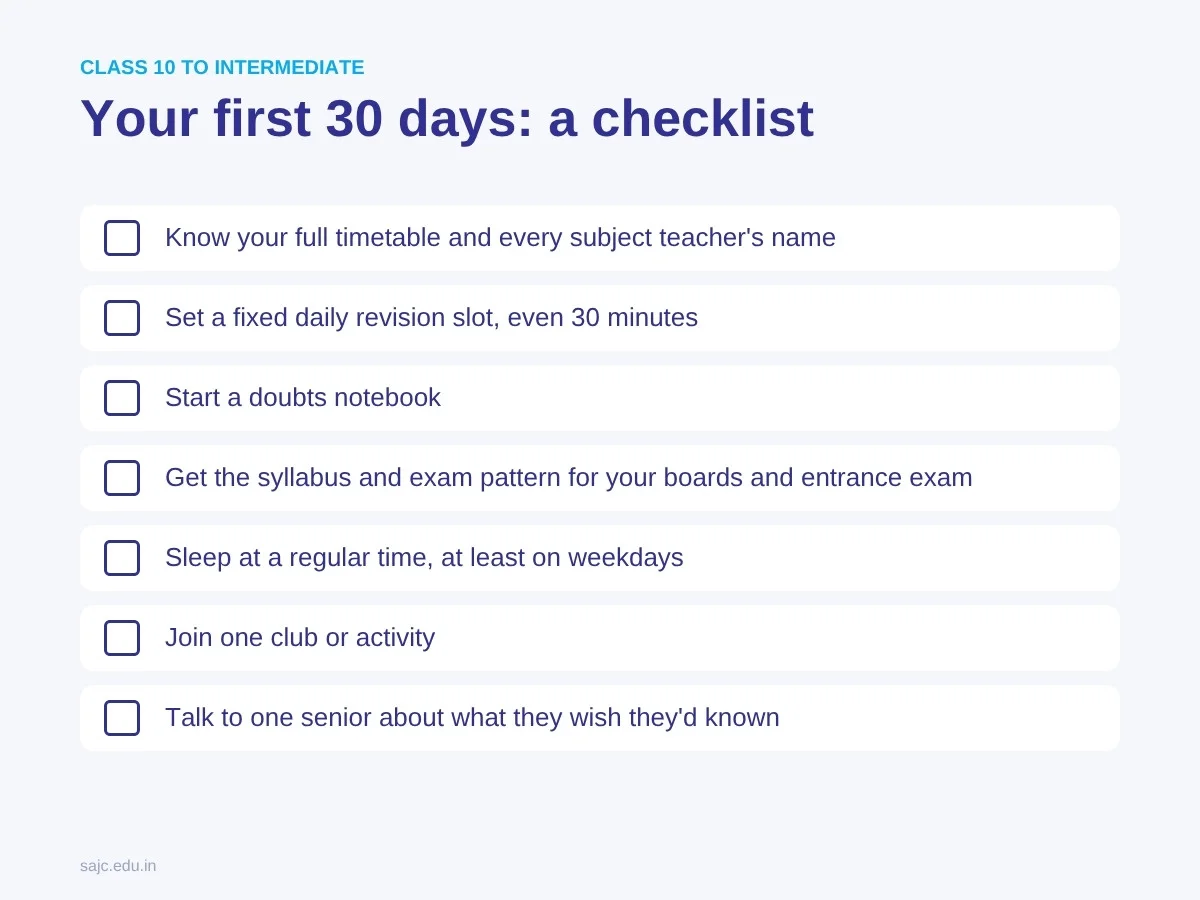
Your first 30 days: a checklist
- ☐ Know your full timetable and every subject teacher’s name
- ☐ Set a fixed daily revision slot, even 30 minutes
- ☐ Start a doubts notebook
- ☐ Get the syllabus and exam pattern for your boards and your entrance exam
- ☐ Sleep at a regular time, at least on weekdays
- ☐ Join one club or activity
- ☐ Talk to one senior about what they wish they’d known
Look after yourself, too
Stress, self-doubt and homesickness for school friends are all normal in the first few months. Keep your friendships, take real breaks and talk to a parent, teacher or mentor when things feel heavy. Asking for help is a sign of growth, not weakness.

For parents: 5 questions to ask any junior college
If your child is choosing a college right now, these questions tell you more than a brochure.
- How do you help a student choose between MPC, BiPC, MEC and CEC?
- How are board preparation and entrance preparation balanced in the daily timetable?
- How will I know how my child is doing, and how often?
- What happens when a student falls behind or loses confidence?
- What does a student do here besides classes?
Comparing a few colleges? Our guides on what makes the best junior college in Hyderabad and day scholar vs semi-residential colleges can help you weigh them.
The best way to get honest answers is to visit, sit in the campus and ask. At Sri Amogha in SR Nagar, families who visit can take a free career test and counselling session and talk through stream choice before deciding. You can also watch how admission at SAJC works.
🖼️ IMAGE — Parent and student at the counselling table with a staff member. Use the refreshed reception/meeting room once the interior work is done

YouTube loads when you choose. Its privacy terms apply.
Frequently asked questions
How is Intermediate different from Class 10?
The pace is faster, chapters build on each other, and students are expected to manage their own revision. Most students also start entrance exam preparation alongside boards.
When should I start JEE, EAPCET or NEET preparation?
From the first year. Strong concepts in first year make both board exams and entrance exams easier later.
Which stream should I choose after Class 10?
It depends on interests and strengths, not just marks. Read why career counselling before Intermediate admission matters and our guide on which course is best after 10th.
Looking ahead
The next two years will bring challenges, small wins and lessons. Approach them with curiosity and consistency. Intermediate is not just preparation for exams. It’s preparation for the way you’ll learn for the rest of your life.
Admissions for 2027–28 are open at Sri Amogha Junior College, SR Nagar. Not sure which stream fits? Talk it through with us before you decide. Book a career-counselling conversation · Download the brochure · See all courses
Explore IPNET, IPSET, IPMED and Classic Commerce at SAJC, or visit with your parent for a counselling conversation.
Explore courses Plan a counselling visit →