
SAJC resources
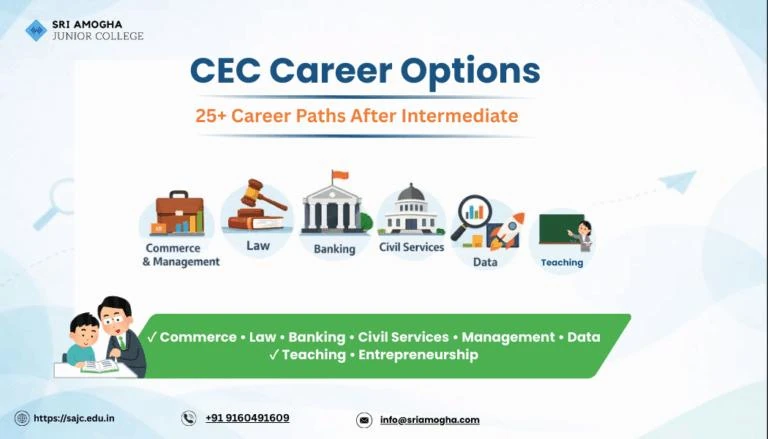
CEC Career Options After Intermediate
Sri Amogha Junior College · Updated 31 October 2026
After CEC which course is best
Choosing the right career after completing intermediate education is one of the most crucial decisions for students, especially for those from the CEC stream — Political Science (commonly called Civics), Economics and Commerce. With changing industry demands and expanding professional landscapes, career options for CEC students are no longer limited to traditional paths. Today, CEC career options span across commerce, finance, law, management, government services, entrepreneurship, and emerging business domains.
CEC is a popular intermediate group offered by boards like the Board of Intermediate Education, Andhra Pradesh, and the Telangana State Board of Intermediate Education, designed for students who have strong analytical, communication, and decision-making skills. Subjects such as economics, civics, and commerce lay a solid foundation for understanding business operations, public administration, and socioeconomic systems, making CEC students well suited for both professional courses and competitive exams.
Watch a related SAJC conversation
YouTube loads when you choose. Its privacy terms apply.
What is CEC Full Form? Is it a Good Option? Career Options after CEC Intermediate
An introduction to CEC and the choices after Intermediate. SAJC’s accompanying note asks families to judge each subject combination on its own merits.
What is CEC and Its Importance in Education?
CEC plays an important role in shaping students, understanding of economic systems, governance, trade, and social structures. Unlike purely science or arts based streams, CEC provides a balanced mix of analytical, theoretical, and practical knowledge. This is why career options for CEC students are diverse and extend across education, commerce, civil services, management, and social sciences.
CEC programs are designed to introduce students to core subjects that are highly relevant to real world applications and professional careers. The primary subjects include
- Commerce: Focuses on accounting basics, business organization, trade, and financial literacy.
- Economics: Covers microeconomics, macroeconomics, national income, and economic development.
- Political Science (commonly called Civics): Deals with governance, constitution, public administration, and political systems.
Through these subjects, students develop critical thinking, data interpretation, policy understanding, and communication skills. This academic structure prepares students for popular degree courses such as B.COM, BBA, BA Economics, BA Political Science, and education related career paths after CEC.
Importance of CEC in Shaping Future Educators
A highly valuable aspect of CEC is its role in developing future educators, lecturers, and academic professionals. Subjects like economics and civics form the backbone of humanities and social science education, which are essential teaching disciplines in schools, colleges, and universities.
CEC students who pursue higher studies such as a BA, MA, B.Ed, or M.Ed often become:
- School teachers (economics, social studies, civics)
- College lecturers
- Academic counselors
- Education content developers
Top CEC Career Options after Intermediate
1. Bachelor of Commerce (B.Com)
Overview:
Bachelor of Commerce (B.Com) is one of the most popular and versatile career options for CEC students. It builds a strong foundation in accounting, finance, taxation, economics, and business law. Many professional and postgraduate courses are built on top of a B.Com degree.
Eligibility:
CEC students who have passed Intermediate (10+2) from a recognized board are eligible. Some universities may have merit-based cutoffs.
Duration:
3 years (full time)
Career Roles:
- Accountant
- Finance Executive
- Auditor
- Tax Consultant
- Business Analyst
2. Bachelor of Business Administration (BBA) – UG entry
Overview:
BBA focuses on business management, leadership, marketing, HR, and operations. It is an excellent option for CEC students who aim for managerial or corporate leadership roles.
Eligibility:
CEC students meet minimum marks criteria, some institutes conduct entrance exams.
Duration:
3 years
Career Roles:
- Management Trainee
- Marketing Executive
- Business Development Executive
- Operations Analyst
3. Chartered Accountancy (CA)
Overview:
Chartered accountancy is one of the most respected and highest-paying career options for CEC students. It covers accounting, auditing, taxation, corporate law, and financial management.
Eligibility:
CEC students can enroll after Intermediate through the CA Foundation route.
Duration:
Minimum 4.5 – 5 years (depends on exam clearance)
Career Roles:
- Chartered Accountant
- Auditor
- Tax Consultant
- Financial Advisor
3. Chartered Accountancy (CA)
- Chartered Accountant
- Auditor
- Tax Consultant
- Financial Advisor
4. Company Secretary (CS)
Overview:
The company secretary focuses on corporate governance, compliance, company law, and regulatory frameworks. CS professionals play a crucial role in corporate decision-making.
Eligibility:
CEC students can enroll directly after Intermediate.
Duration:
3-4 years
Career Roles:
- Company Secretary
- Compliance Officer
- Corporate Legal Advisor
5. Law (LLB / BA LLB)
Overview:
Law is a powerful and respected career option for CEC students, especially due to their background in civics and economics. Students can pursue integrated law courses right after Intermediate.
Eligibility:
CEC students can apply for 5-year integrated law programs.
Duration:
5 years (integrated) / 3 years (after graduation)
Career Roles:
- Advocate
- Corporate Lawyer
- Legal Advisor
- Judge (with experience)
6. Economics
Overview:
Economics focuses on data analysis, policy evaluation, and economic theory. It opens doors to research, policymaking, and analytical roles.
Eligibility:
CEC students, especially those with an economics background.
Duration:
3 years (UG)
Career Roles:
- Economist
- Policy Analyst
- Research Associate
- Data Consultant
7. Hotel Management
Overview:
Hotel management offers careers in hospitality, tourism, and service industries, both in India and abroad.
Eligibility:
CEC students from any board.
Duration:
3 – 4 years
Career Roles:
- Hotel Manager
- Hospitality Executive
- Resort Manager
8. Digital Marketing
Overview:
Digital marketing is one of the fastest-growing career options after CEC. It focuses on online branding, SEO, advertising, and social media.
Eligibility:
CEC students after Intermediate or graduation.
Duration:
6 months – 2 years
Career Roles:
- Digital Marketer
- SEO Specialist
- Social Media Manager
9. Civil Services
Overview:
Civil Services offer prestige, authority, and public service roles through competitive exams like UPSC and State PSC.
Eligibility:
Graduation in any discipline (CEC students eligible).
Duration:
1 – 3 years of preparation
Career Roles:
- IAS
- IPS
- IRS
- State Administrative Officer
10. Banking and Financial Services
Overview:
Banking is a stable and respected career option for CEC students, especially in public and private sector banks.
Eligibility:
Graduation and banking entrance exams.
Duration:
3 years + exam preparation
Career Roles:
- Bank Officer
- Credit Analyst
- Relationship Manager
11. Public Administration
Overview:
Public administration focuses on governance, public policy, and administrative systems.
Eligibility:
CEC students with interest in civics and administration.
Duration:
3 years
Career Roles:
- Policy Analyst
- Administrative Consultant
12. Entrepreneurship
Overview:
Entrepreneurship allows CEC students to start and manage their own businesses or startups.
Eligibility:
No formal restriction.
Duration:
Ongoing, skill based learning
Career Roles:
- Startup Founder
- Business Owner
13. Stock Market & Investment Advisory
Overview:
This career involves trading, portfolio management, and financial advisory services.
Eligibility:
CEC students with finance interests.
Duration:
6 months – 3 years
Career Roles:
- Investment Advisor
- Trader
- Portfolio Manager
14. Teaching and Academia
Overview:
Teaching allows students to build careers in education and research.
Eligibility:
Graduation + B.Ed./NET (as required)
Duration:
3 – 6 years
Career Roles:
- Teacher
- Lecturer
- Professor
15. Event Management
Overview:
Event management involves planning and executing corporate and social events.
Eligibility:
CEC students after Intermediate.
Duration:
1 – 3 years
Career Roles:
- Event Planner
- Operations Manager
16. Mass Communication and Journalism
Overview:
Mass communication focuses on media, journalism, advertising, and content creation.
Eligibility:
CEC students from any board.
Duration:
3 years
Career Roles:
- Journalist
- Content Writer
- Media Analyst
17. Cost and Management Accountant (CMA)
Overview:
CMA is a professional course focused on cost control, financial planning, budgeting, and internal business decision-making in organizations.
Eligibility:
CEC students can enroll after Intermediate through the CMA Foundation route.
Duration:
3 – 4 years
Career Roles:
- Cost Accountant
- Management Accountant
- Financial Controller
18. Master of Business Administration (MBA) – PG
Career Roles:
- Cost Accountant
- Management Accountant
- Financial Controller
19. Business Analytics / Data Analytics
Overview:
Business analytics and data analytics focus on analyzing business data to support decision-making and improve organizational performance.
Eligibility:
CEC students after Intermediate or graduation; basic analytical skills preferred.
Duration:
6 months – 2 years
Career Roles:
- Business Analyst
- Data Analyst
- BI Analyst
20. Bachelor of Computer Applications (BCA)
Overview:
BCA is an undergraduate program focused on computer applications, software development, and IT systems, offering a technical career path for CEC students.
Eligibility:
CEC students who have completed intermediate mathematics may be required by some universities.
Duration:
3 years
Career Roles:
- Software Developer
- Web Developer
- System Analyst
- IT Support Executive
21. Bachelor of Vocation (B.Voc)
Overview:
B.Voc is a skill-based degree program designed to provide industry-specific practical training along with academic learning.
Eligibility:
CEC students after Intermediate from a recognized board.
Duration:
3 years (multiple exit options available)
Career Roles:
- Skill Specialist
- Operations Executive
- Industry Technician
22.Export Management – UG Entry
Overview:
Focuses on international trade, export operations, logistics, and global business practices.
Eligibility:
CEC students with qualifying marks.
Duration:
3 years
Career Roles:
- Export Executive
- Logistics Coordinator
- International Business Executive
23.Film Making & Photography – UG Entry
Overview:
Covers visual storytelling, cinematography, photography, and digital media production.
Eligibility:
CEC students; portfolio/aptitude test may be required.
Duration:
3 – 4 years
Career Roles:
- Assistant Director
- Photographer
- Video Editor
24.International Relations – UG Entry
Overview:
Deals with global politics, diplomacy, international policies, and world affairs.
Eligibility:
CEC students with academic eligibility.
Duration:
3 years
Career Roles:
- Policy Analyst
- Research Associate
- Foreign Affairs Executive
25.Hospitality & Tourism Management – UG Entry
Overview:
Focuses on hotel operations, tourism services, travel management, and customer experience.
Eligibility:
CEC students with qualifying marks.
Duration:
3 – 4 years
Career Roles:
- Hotel Executive
- Tourism Manager
- Guest Relations Officer
26.Art, Design & Fine Arts – UG Entry
Overview:
Develops creativity, design skills, visual communication, and artistic expression.
Eligibility:
CEC students; portfolio may be required.
Duration:
3 – 4 years
Career Roles:
- Graphic Designer
- Visual Artist
- Illustrator
Common Career Mistakes CEC Students Should Avoid
Many students limit their growth due to misinformation or poor planning.
Mistakes to Watch Out For:
- Assuming CEC has fewer career options
- Choosing careers based only on peer pressure
- Ignoring skill development
- Not exploring government and education sector opportunities
- Delaying career planning until after graduation
Avoiding these mistakes helps students fully utilize CEC career options after intermediate.
How to Choose the Right Career Option After CEC
One of the biggest challenges CEC students face is choosing the right career path. With so many CEC career options available, confusion is natural. However, choosing the right career becomes easy when students follow a step by step approach instead of rushing decisions.
1. Understand Your Interests First
The most important rule:
Do not choose a career just because others are choosing it.
Students should ask themselves:
- Do I enjoy economics, commerce, or civics more?
- Do I like reading, speaking, managing, or analyzing?
- Do I prefer government jobs or private sector roles?
Interest-based choices lead to long-term success and job satisfaction.
2. Identify Your Strengths & Skills
Every student has different strengths.
For example:
- Good at speaking: Law, Teaching, Civil Services
- Good at numbers: Accounting, Banking, Economics
- Good at leadership: Management, Entrepreneurship
- Creative & digital: Marketing, content, branding
Matching skills with career options reduces stress and failure.
3.Consider Education Path & Time Commitment
Some careers require:
- Long preparation (civil services, CA, law)
- Higher studies (MBA, MA, M.Com)
- Professional certifications
Students should honestly evaluate:
- How much time they can dedicate
- Willingness to study long-term
- Financial planning
4. Take Career Guidance & Counseling
Professional guidance plays a major role in choosing the right career.
Students should:
- Talk to teachers and lecturers
- Consult career counselors
- Attend career seminars
- Interact with seniors and alumni
Early guidance helps students avoid wrong decisions and career changes later.
5. Plan for the Long Term, Not Just the First Job
A good career is not just about the first salary.
CEC students should think about:
- Growth opportunities
- Job stability
- Respect and authority
- Work life balance
- Future scope
Many CEC career options offer slow beginnings but excellent long-term growth.
FAQs
1. What are the best career options for CEC students after intermediate?
- The best career options for CEC students after intermediate include commerce, management, law, civil services, banking, economics, digital marketing, data analysis, and entrepreneurship. The right choice depends on skills, interests, and long term career goals.
2. What courses can CEC students pursue after intermediate?
- After intermediate, CEC students can pursue degree courses like B.Com, BBA, BA Economics, BA Public Administration, integrated law programs, and professional courses such as CA, CS, CMA, and CFA, along with skill-based certification programs.
3. Is B.Com a good career option after CEC?
- Yes, B.Com is one of the best career options after CEC. It provides a strong foundation in accounting, finance, taxation, and business, and it allows students to pursue higher studies or professional courses like CA, MBA, or finance certifications.
4. Can CEC students pursue management courses?
- Yes, CEC students can pursue management courses such as BBA after intermediate and MBA after graduation. These courses are suitable for students interested in business management, leadership roles, and corporate careers.
5. Is chartered accountancy suitable for CEC students?
- Yes, chartered accountancy is a suitable and popular option for CEC students. Commerce and economics subjects help in understanding accounting, taxation, and financial management concepts required for the CA course.
6. Is a company secretary a good career after CEC?
- Company secretary is a good career option after CEC for students interested in corporate law, compliance, and governance. It offers strong career growth and opportunities in corporate and legal domains.
7. Can a CEC student pursue law after intermediate?
- Yes, CEC students can pursue law after intermediate through 5-year integrated law courses. Subjects like civics and economics are directly relevant and helpful for legal studies and competitive law entrance exams.
8. What law careers are available for CEC students?
CEC students can build careers as advocates, corporate lawyers, legal advisors, compliance officers, judicial services aspirants, and policy professionals after completing legal education.
9. How can BiPC students prepare effectively for competitive exams?
-
Effective preparation includes strong subject fundamentals, regular practice, structured revision, mock tests, and guidance aligned with exam requirements and academic goals.
10. How should students choose the right career path after BiPC?
-
Students should consider their interests, strengths, academic performance, and long-term goals. Exploring different career options and seeking academic guidance can help in making informed decisions.
11. Can CEC students prepare for civil services?
- Yes, CEC students are well suited for civil services preparation. Subjects like civics, economics, and public administration form the core syllabus of civil service examinations.
12. Is public administration useful for CEC students?
- Public administration is useful for CEC students aiming for government jobs, administrative roles, civil services, policy research, and governance-related careers.
13. Can CEC students work in the stock market field?
- Yes, CEC students can work in the stock market as traders, investment advisors, portfolio managers, or financial analysts with proper training, certifications, and market knowledge.
14. Can CEC students become data analysts?
- Yes, CEC students can become data analysts by learning tools such as Excel, SQL, Power BI, or Python. Commerce and economics knowledge helps in business and financial data analysis roles.
15. What teaching careers are available after CEC?
- After CEC, students can pursue teaching careers by completing graduation, postgraduation, and required teaching qualifications. Careers include school teacher, lecturer, professor, and academic researcher.
These pathways involve further education and may require entrance tests, professional training or registration. A subject combination does not automatically qualify a student for a degree or profession. Check the current institution and regulator requirements. Earning prospects vary by qualification, role, employer, location and experience; no salary is promised here.
Explore IPNET, IPSET, IPMED and Classic Commerce at SAJC, or visit with your parent for a counselling conversation.
Explore courses Plan a counselling visit →