
SAJC resources
Why Public Speaking Matters for Students: Marks Are Not Enough
Sri Amogha Junior College · Updated 24 November 2026
By Nikhilesh Bharadwaj, Director, Sri Amogha Institutions
A student can score 95%. They can solve difficult Maths problems, remember complex Chemistry reactions and write excellent exam answers.
Then someone asks: “Tell me about yourself.”
For many students, that simple question becomes the hardest one of the day. They know the answer. They just don’t know how to say it.
That’s why communication, confidence and public speaking shouldn’t be treated as optional extras. Students use these skills long after their Intermediate exams are over. Public speaking skills for students are built through practice, not born.
Watch: taking the first step to speak
In this SAJC conversation, we discuss why students need opportunities to speak as well as prepare for exams. Start with a short introduction and build up through practice.
8 July 2026 · 2:04 · Sri Amogha Junior College

YouTube loads when you choose. Its privacy terms apply.
Choose one small speaking task for this week. Try it with someone you trust, ask what was clear and decide what to improve next.
Where students actually need to speak
At college, in entrance interviews and at work, students will need to:
- present an idea to a group
- explain their work to a teacher or interviewer
- take part in a discussion or work in a team
- speak to people they don’t know
- ask questions when they don’t understand
- disagree respectfully and handle an unexpected question
A student doesn’t need to become a brilliant orator. But they should be able to express themselves without fear holding them back.

YouTube loads when you choose. Its privacy terms apply.
Confidence doesn’t appear suddenly
The biggest myth about confidence is that some students “have it” and others don’t. In reality, confidence usually comes from repeated exposure to situations that felt uncomfortable at first.
Telling a nervous student “don’t be scared” doesn’t work. Giving them a chance to speak does. Then another. Then another.
The first presentation may come with shaking hands and forgotten lines. The fifth will be better. By the tenth, many students realise: “I can actually do this.”
Why we sometimes have to push
Ask a class, “Who wants to come on stage?” The same few hands go up. The quieter students look down.
“Sir, next time.” “I’ll do it later.” “I’m not comfortable.”
That reluctance is understandable. But if students can avoid every uncomfortable situation, they never get the chance to build the skill. Sometimes, doing it first is how you become comfortable with it later.
The stage-fear ladder
Nobody goes from silent to anchoring an event in one jump. Climb one rung at a time:
- Answer one question aloud in class
- Explain a solution to a friend or small group
- Present a short topic to your class
- Take part in a group discussion or debate
- Speak or perform at a college event
- Organise or anchor an event
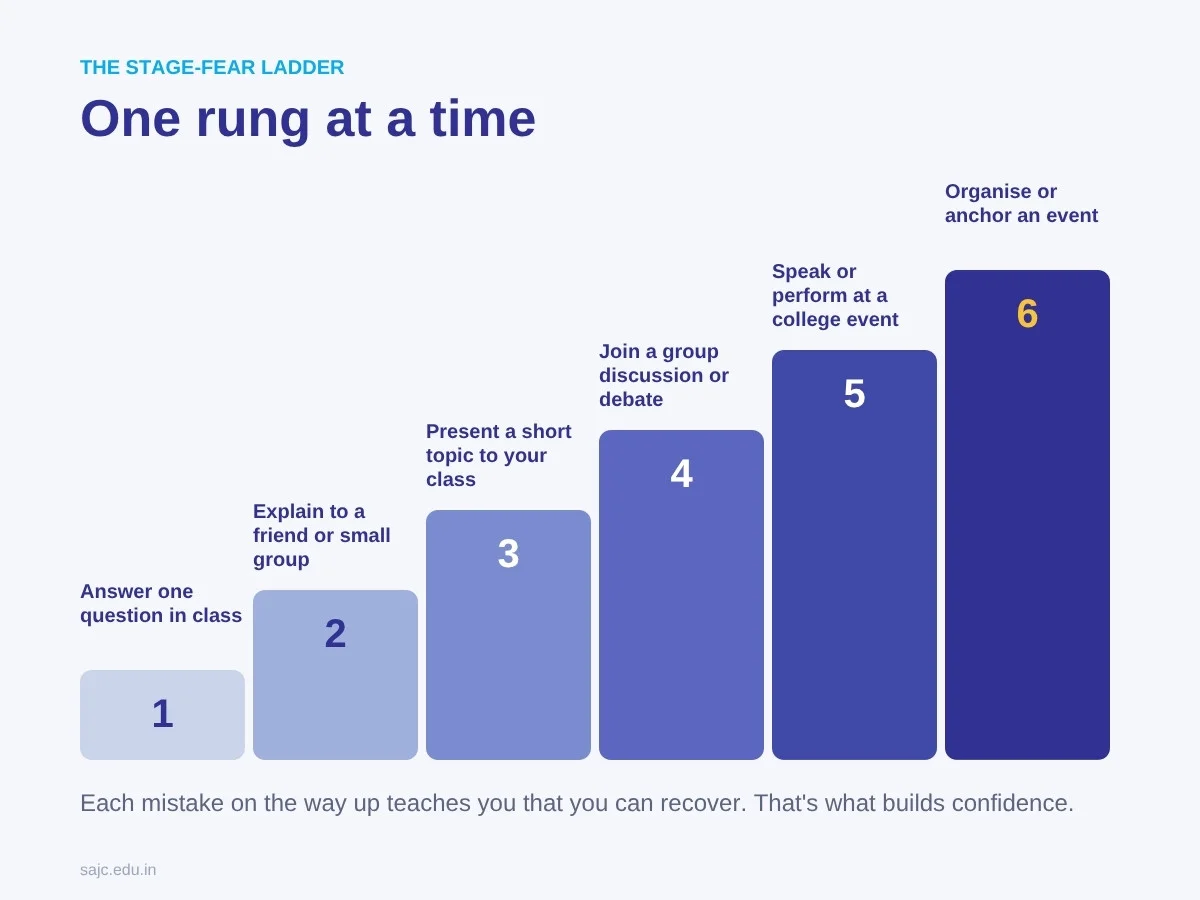
At each step, students learn that a mistake in front of others isn’t the end of the world. They forget a line. They stumble. They get a tough question. They recover. That recovery is what builds confidence.
A 60-second “tell me about yourself” template
Use this for interviews, introductions and college events. Practise it aloud until it feels natural. You can even use AI as a mock interviewer.
On a phone, swipe the table sideways to compare. With a keyboard, focus the table and use the arrow keys.
| Part | What to say | Example |
|---|---|---|
| Present (15 sec) | Who you are now | “I’m Ananya, a second-year MPC student at Sri Amogha.” |
| Past (20 sec) | One thing that shaped you | “I got into coding when I built a small app for our class timetable.” |
| Strength (15 sec) | What you’re good at, with proof | “I enjoy breaking down hard problems. I helped my team finish our science project.” |
| Future (10 sec) | Where you’re heading | “I’m preparing for JEE and want to study computer science.” |
Public speaking skills for students go beyond speaking
Preparing a presentation forces a student to understand the topic, organise their thoughts and decide what matters. Delivering it teaches them to read an audience and adjust when things go off-script. A debate adds careful listening. A group project teaches coordination. Organising an event teaches planning and composure.
So public speaking for students doesn’t only create better speakers. It creates clearer thinkers.
Knowing vs expressing
Two students understand the same topic. Student A struggles to explain it. Student B explains it clearly.
In an exam, both may do well. Outside the exam hall, the difference becomes obvious: in interviews, group projects, presentations and eventually at work. Knowledge still matters enormously. The ability to communicate it matters too. (See our guide to interpersonal skills for students.)
How we build public speaking skills for students at Sri Amogha
If communication matters, it can’t be limited to one annual event. It has to be part of everyday college life.
- Personality Development Club: sessions led by Nikhilesh where students explore self-awareness, values and character through conversation, reflection and their own work.
- Student Council: students take on leadership roles and represent their classmates.
- Events like Prana and Fun Fest: chances to perform, organise and speak in front of an audience.
- Student voices: on International Youth Day, students shared the one change they’d make in the world. (Watch here.)
- Volunteering: working with people outside college, like the Hyderabad Marathon, builds confidence in a different way.

YouTube loads when you choose. Its privacy terms apply.

The aim isn’t to turn every student into a professional speaker. It’s to make sure a lack of confidence never stops a student from showing what they’re capable of.
Public speaking skills for students: FAQs
Why is public speaking important for students?
It helps them explain what they know, perform well in interviews, work in teams and think more clearly. Those skills matter in college and at work, not just on stage.
How can a student overcome stage fear?
Through gradual, repeated practice: speaking in class, then small groups, then larger audiences. Each experience makes the next one easier.
How should a student answer “tell me about yourself”?
Keep it to about a minute: who you are now, one thing that shaped you, a strength with proof, and where you’re heading.
Marks open the door. What happens next?
Good marks help students get into courses and colleges. But eventually every student has to introduce themselves, answer questions, present ideas and work with others.
Perhaps the most rewarding thing isn’t watching a confident student give a great talk. It’s watching the student who couldn’t introduce themselves in first year stand in front of an audience and speak with confidence.
That doesn’t happen because of a lecture on confidence. It happens because someone kept giving them the chance, and gave them a little push when they needed it. That’s how public speaking skills for students really grow.